You loaded your multitrack into an AI mixing tool, it made a thousand small decisions, and it handed you back a stereo file. If you like it, you are finished. If you like most of it, you are stuck — because the one thing you want to change is now welded to everything else.
This is the part nobody mentions in the pitch. A stereo bounce is a verdict, not a working file. You cannot pull the snare down two decibels inside a finished mix. You cannot run the vocal through the chain you have spent years assembling. You cannot take the parts that worked and redo the parts that did not.
Getting the stems back solves that. But "the stems" is ambiguous, and the ambiguity matters more than it sounds.
Three things "give me the stems" can mean
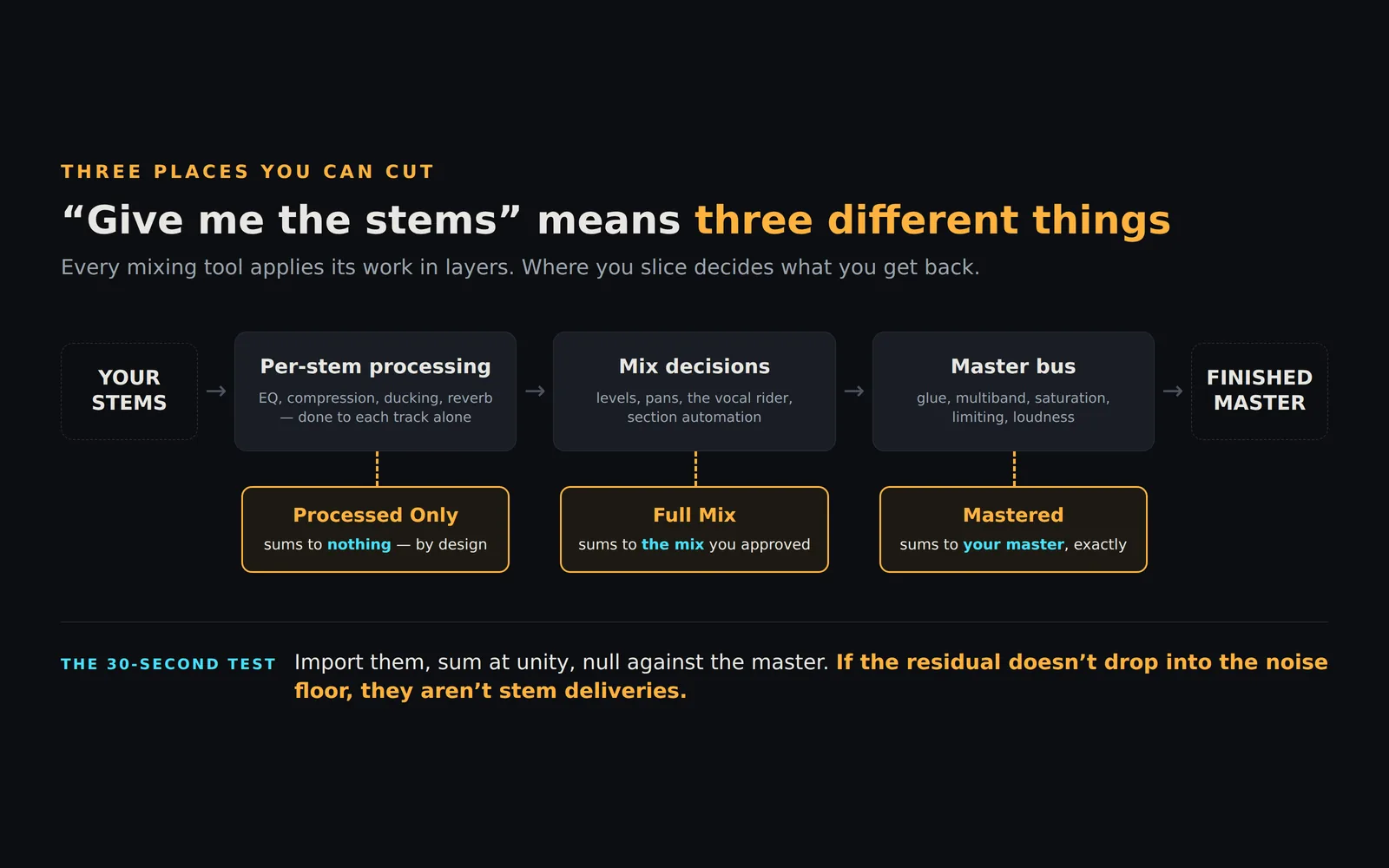
Any mixing tool applies its work in layers. Roughly:
- Per-stem processing — EQ, compression, ducking one element under another, reverb and delay. Work done to each track, in isolation.
- Mix decisions — levels, panning, riding a vocal up through a busy section, automating a filter across a breakdown. Work done to place tracks relative to each other.
- The master bus — glue compression, multiband, saturation, limiting, loudness. Work done to the finished sum.
So there are three sensible places to cut, and they suit different people:
Stems with only their own processing
Each track cleaned up, at unity gain and dead centre. No levels, no pans, no automation. You get the tedious work — the surgical EQ, the compression settings, the ducking — and every judgement call stays yours.
This is the one to take if your material sits a long way from a conventional balance. Any AI mixer is reasoning from what most records do. If you produce something where the kick is supposed to dominate in a way most records would consider broken, its level decisions will fight you, and you will redo them anyway. Take the cleanup, skip the opinion.
Stems with the mix baked in, but no master
Everything from the first list and the second: levels, pans, rides, automation. Everything except the master bus.
Take this one if you liked the mix and only want to master it yourself, or hand it to a mastering engineer who will. The useful property is that these sum back to exactly the mix you approved — drop them into a DAW, leave every fader at zero, and you have the mix you heard, now with a mastering chain of your choosing in front of it.
Stems with the master distributed across them
This is what a mastering engineer means by stem delivery: each stem carries its share of the bus processing, so summing them reconstructs the master exactly. It is what you need to hand stems to a label, or to rebalance inside a finished master.
It is also the hardest of the three to do correctly, and the one most likely to be faked. Which brings us to the trap.
The trap: stems that do not add up
There is an obvious way to build that third option, and it is wrong. You take each stem, run it through its own copy of the master chain, and call them mastered stems.
They will not sum to your master. They will not sum to anything.
The reason is that a master bus responds to the sum. A compressor decides how much to pull down based on the level hitting it; a limiter decides where to catch peaks the same way. Feed it one stem alone and it sees a completely different signal from the one it was set up for. The quiet stem gets pushed up, the loud one gets squashed, and when you add them back together you have something louder and differently balanced from the master you approved.
It is easy to build, it sounds plausible in isolation, and it fails the only test that matters. If you are ever handed "mastered stems", the test takes thirty seconds: import them, sum them with everything at unity, and null the result against the master. If the residual does not drop into the noise floor, they are not stem deliveries. They are separate files that happen to have come from the same song.
What we did
StemMaster exports all three, from File → Export Stems: Processed Only, Full Mix and Mastered. One 32-bit float WAV per stem, numbered to match the channel order so they land in a DAW already lined up, and anything you muted is left out rather than written as a silent file.
Float rather than fixed-point, for a reason that only shows up in stem exports: a single stem can peak above 0 dBFS quite legitimately, because the stems cancel against each other and only their sum is bounded. A 24-bit file would clip that on the way to disk. Float has no such ceiling, so what lands in your DAW is what the mix actually contained.
Both of the exports that claim to sum to something are held to the null test described above, in the automated test suite, on every commit — the exported stems have to reconstruct their target or the build fails. That is a strange thing to put in a blog post, except that it is the entire difference between a feature and a claim.
This landed because a customer asked for it in his first week, and described his own use case precisely enough that it changed which version got built first. That remains the most efficient product process we have found.
Updated 6 September 2026. When this was written the third option was designed and not built, and this post said so. It shipped in 1.1.54, held to the same null test as the second: the printed stems sum against the master between 127 and 140 decibels down, measured across sessions with multiband compression, saturation, section automation, and a loud target with the clipper in the signal path. The comparison above is unchanged, because the argument was never about us.