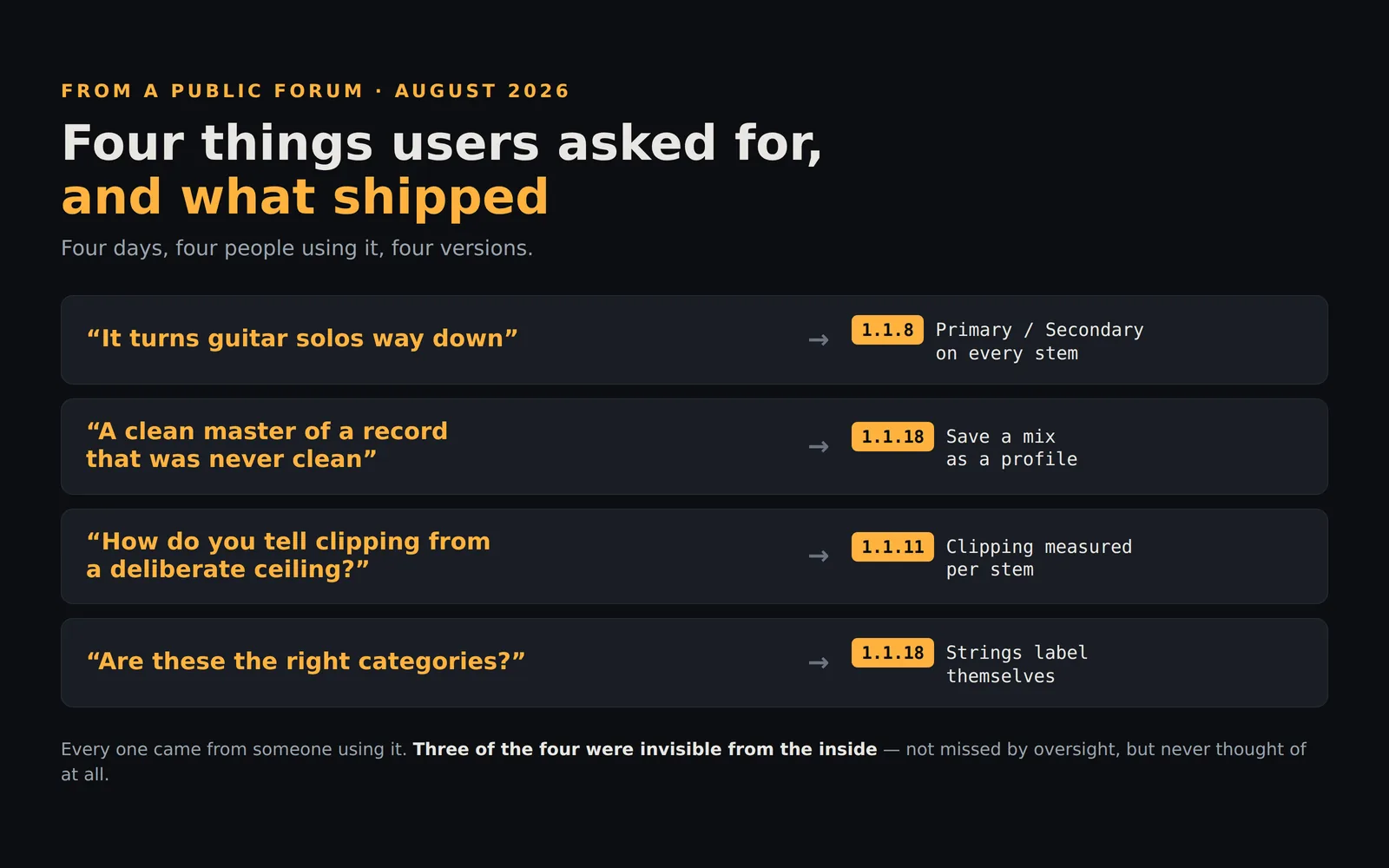
StemMaster went up on a public forum on 8 August 2026. Over the next four days four people used it and said what was wrong with it. Every one of those conversations turned into a shipped version, usually the next day.
This is not a story about being responsive. It is a story about what you find out when the thing is in somebody else's hands, and none of the four below would have been found any other way.
“It turns guitar solos way down”
The first report was precise: the core of a mix came out fine, but a guitar solo got pushed under everything. The person reporting it also supplied the fix — let me say which stems matter.
He was right about the cause. Every stem gets a starting level from what the app decides it is, measured against the drums. Vocals begin at +0.5 dB, guitar at −3.5 dB. That is a sensible convention for a rhythm guitar and completely wrong for a solo, and the labeller cannot tell them apart — they are both “guitar”, and nothing in the audio reliably says which is which.
1.1.8 added Primary and Secondary, a box under each stem's type. Marking a stem Primary brings it forward 2.5 dB from whatever its type would otherwise get; Secondary pushes it back the same. A solo that was sitting 3.5 dB under the drums lands 1 dB under instead.
Two days later 1.1.10 fixed something worse that the first fix exposed: the setting looked like it stayed put between renders and did not. It was visibly set and silently ignored, which is the kind of bug that makes someone conclude the feature does not work rather than that it broke.
“A clean master of a record that was never clean”
The best argument anyone made was about what mastering is for. Feed StemMaster the full multitrack of a classic record, the point went, and you get a technically clean master of a record whose character is partly that it is not clean. The example given was What's Going On.
There was no answer to that. The six built-in profiles are tonal destinations — Warm/Vintage, Bright/Modern, Bass-Heavy — and six destinations are not a map of recorded music.
So profiles became writable, and 1.1.18 made the easy route need no file format at all: master a song, move the faders and width sliders until it sounds right, then File › Custom Profiles › Save This Mix as a Profile. Your deviations from the engine's own decisions become the profile. The by-hand route is still there for anyone who wants to write one out.
“How do you tell clipping from a deliberate ceiling?”
The same person asked what the engine actually measures about distortion, and got a straight answer: nothing about harmonic structure, saturation or clipping was measured at all.
1.1.11 added it. Every stem now carries
flat_ratio, flat_runs and
longest_flat_run — stretches of consecutive samples
pinned at that stem's own peak.
Relative to its own peak, not to full scale, and that distinction was the whole point of the request. Material that was clipped and then gain staged down no longer reads as clean just because it no longer touches 0 dBFS. A deliberately squashed drum bus and an accidentally clipped one look different now.
“Are these the right categories?”
A producer working in progressive house asked a question that sounded like a beginner's and was not: he had been assigning Strings by hand, and wanted to know whether he was doing it right.
He was — and he had to. “string” matched
nothing in the labeller at all. A file called
Strings.wav fell through to Other and missed the high-pass
and compressor conventions its type would have given it. Nobody had
noticed because everyone who hit it did what he did: fixed it by hand
and moved on.
1.1.18 made strings auto-label, along with violin, viola, cello and the rest. His other question — Sub Bass to Bass — he had already got right: Bass is the only label with a 24 Hz high-pass, and every other label sits between 80 and 120 Hz, so labelling a sub as anything else filters out its fundamental.
What this is worth saying out loud
Four requests, four shipped versions, and the longest gap was about a day. That is not a promise about future turnaround — it is what happened when there were four people using it and one person building it, and it will not scale unchanged.
The reason to write it down is different. Three of those four problems were invisible from the inside. The guitar-solo convention looked correct in the code and is correct for rhythm parts. The clipping measurement was not missing by oversight, it had never been thought of. The string labels were absent for weeks and produced no error, no warning and no visible symptom — only a slightly worse master that nobody could trace.
Everything above is on the record: the forum thread is public and dated, and every version named here is in the changelog with what changed in it.