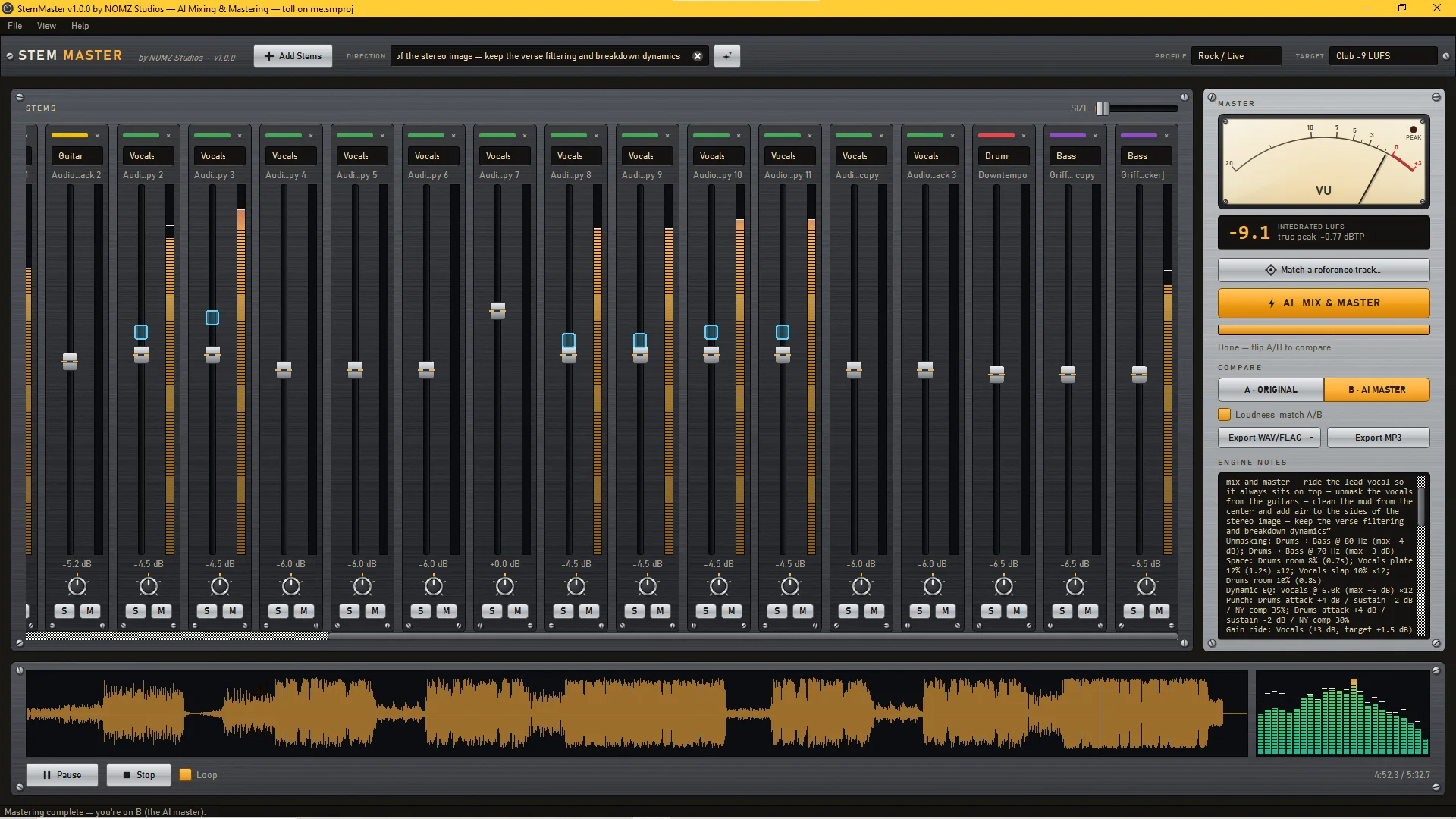
Load your stems. Press one button. StemMaster analyzes every track, mixes and masters to industry standards — and explains every decision it made, while you watch the faders ride your mix in real time.
Most AI audio tools are a black box: song in, master out, shrug. StemMaster is the opposite.
Questions? We answer them in public on our Gearspace thread.
Four stems in, one button, and a finished master — with every decision written down on the way past. No install required to watch: the console you see is the application, not a mock-up.
There are eight more, one per feature — the two engines, direction in plain English, reference matching, stem export and the rest. Prefer YouTube? Open this one there or the whole playlist.
Het dance/techno nummer was eigenlijk meteen wel veel beter dan wat ik er tot nu toe van gemaakt had en werd veel ruimtelijker en helderder, eigenlijk zoals alle nummers klinken tegenwoordig.
The dance/techno track was immediately much better than what I had made of it so far, and became much more spacious and clearer — actually the way all tracks sound these days.
Four raw stems — drums, bass, synth, FX. The “before” is those stems summed flat with a limiter on them, which is what most people actually do. The “after” is the same stems through StemMaster's AI engine, asked for an industry-standard hiphop mix, with no human touching a fader. Switch between them mid-playback; the position is held, so you're comparing the same bar, not the same song twice.
Both clips are level-matched to within 0.03 dB. A master is louder than a raw sum, and louder wins every blind test regardless of whether it's better — so the level difference is removed and only the mix is left to judge. The “before” is limited rather than simply turned up because the bare sum clips by 5.4 dB at this loudness, and a distorting opponent would flatter the master for damage the mastering never fixed.
Industry-standard hiphop: kick/808 low end owns the mix, so instead of ducking the whole bass I used a kick-keyed spectral cut at 70 Hz to keep the sub clean, and high-passed the sub-heavy FX bed at 110 Hz so only drums and bass live below. Drums get transient snap and light parallel density with a dynamic tame on spitty hi-hat spikes; the wide synth bed is lifted and brightened to fill the top since there are no vocals.
On the master, multiband compression evens the flux-heavy low band (13 dB flux), gentle 1.8:1 glue plus mild saturation add punch and density, and mid/side EQ clears center mud while adding side air; low end already measures mono so no fold-down needed.
Listened back and corrected: lifted air 2.0 dB.
Most AI audio tools are a black box: song in, master out, shrug. StemMaster is the opposite. Amber marks show every decision the AI made. Cyan needles dance in real time as section automation and the vocal rider work your mix. And the Engine Notes panel writes it all down in plain English — what was done, to which stem, and why the measurements justified it.
Every step of the process is logged in an "Engine Notes" panel, showing which track was adjusted, by how much, and why, so users can review it.
Nothing here is a preset. StemMaster measures your audio first and only applies what the measurements justify — a mix that doesn't need widening doesn't get widened. Each card is a problem you've probably had, and the tool that fixes it.
Stem-aware AI mixing. Balances, pans, EQs and compresses each stem by its measured role — kick vs bass masking resolved, mono support elements placed off-center, stereo prints left alone.
Section automation. Detects your song's structure — verses, drops, breakdowns — and rides gain, pan, filters, reverb and stereo width per section. Muffled verses that explode into choruses.
Vocal rider. A slow envelope follower pins your lead to the mix word-by-word — the fader ride an engineer does by hand, bounded and never pumping.
Spectral unmasking. The kick ducks only the bass's low band. The vocal dips only the guitars' presence — and only while it sings. Surgical, modern, inaudible until you A/B it.
Punch tools. Transient shaping re-sharpens squashed drums; parallel (NY) compression blends density under thin kits without eating the hits.
Three reverbs + slap. Plate, room and hall characters — chosen per stem, sent only to elements that measure dry, never to the low end.
Master bus, complete. EQ, mid/side EQ, glue and multiband compression, saturation, stereo width, mono-bass fold below 120 Hz — vinyl-safe and mono-proof by construction.
Loudness done right. Streaming −14 or Club −9 LUFS targets, 4× oversampled true-peak limiting, and a soft clipper that engages only at loud targets so club masters punch instead of pump.
Closed-loop refinement. StemMaster listens back to its own render, measures it against the target curve — or a reference track you drop in — and corrects itself before you ever hear it.
Reference matching. Drop in a commercial track: tonal balance, width and dynamics steer toward it while your loudness target is still hit exactly.
Auto-labeling. StemMaster fingerprints the audio and labels drums, bass, vocals and synths for you.
Creative direction. Type what you want — “dark and moody, heavy sub, vocals intimate” — and the AI interprets it into concrete engineering moves, then tells you how.
Drag in WAV, AIFF, FLAC or MP3 stems — 4 or 40 of them. StemMaster labels them automatically and sets up your console.
Choose a profile (Rock/Live, Bass-Heavy, Vocal-Forward…), a loudness target, and optionally type a creative direction. Hit AI MIX & MASTER.
Flip A/B loudness-matched, read the Engine Notes, nudge any fader — then export 24-bit WAV, AIFF, FLAC or MP3 — or 32-bit float — hitting your target within a tenth of a dB.
The engine that does the mixing and mastering is built in. It runs entirely on the user’s own machine, with no account, no connection and no upload, and it is the default.
StemMaster is a real desktop app, not a cloud service wearing one as a costume. All audio analysis and rendering happens locally, on your computer.
One purchase, yours forever. Free updates across the 1.x series.
No sign-in, no usage tracking, no analytics SDK buried in the installer. The one call it makes by itself is a one-time licence activation — then it's offline, rechecking within 30 days so a disconnected machine keeps working.
Your stems and masters are processed entirely on your machine. Only compact measurement summaries are ever sent to an AI model — never audio.
Works out of the box with the built-in analysis engine — fully offline. Plug in your own API key (Anthropic, OpenAI, z.ai, and other compatible providers) to unlock the LLM engine. Your key lives in Windows Credential Manager, not a config file.
Offers transparency by documenting AI decisions and allowing manual overrides.