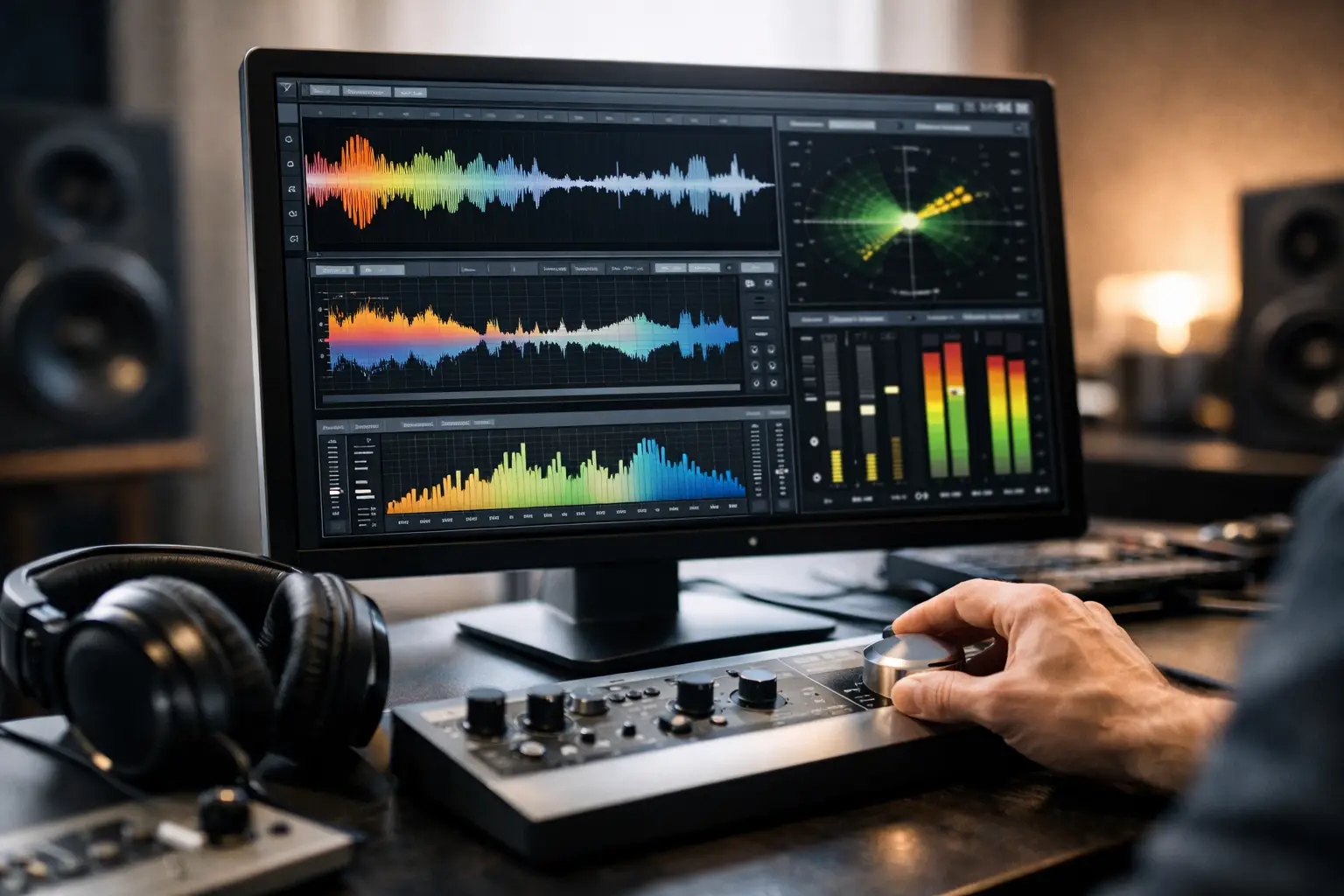
A lead vocal buried by the chorus is not a mastering problem. Neither is a kick drum fighting the bass at 60 Hz, or a guitar wall masking every consonant in the singer’s performance. Yet a stereo-file service can only react to the finished two-track. Offline audio mastering software built to work from stems can address the actual relationship between instruments before the limiter ever touches the final output.
That distinction matters when you have already exported four, 12, or 40 stems from a session and need a release-ready master without spending another night drawing automation, hunting resonances, and second-guessing loudness. The right offline workflow should save engineering time without hiding the engineering from you.
Why Stereo Mastering Has a Hard Ceiling
Traditional stereo mastering starts after the mix is complete. It can shape tonal balance, control overall dynamics, widen or focus the image, and bring a track to competitive loudness. Those are useful finishing moves. But it cannot turn down a hi-hat that is crowding a vocal, make room for the bass under the kick, or lift the chorus vocal independently from the instrumental.
Once every sound is printed into one stereo file, those decisions are fused together. A broad EQ cut may reduce harshness, but it can also dull the vocal and snare at the same time. A compressor may tame a loud chorus, but it may also flatten the groove that made the chorus work.
Stem-level processing changes the available options. The system can identify likely musical roles, examine conflicts between those roles, and make targeted changes where they are justified. That can mean spectral unmasking between vocal and guitars, low-end management between kick and bass, section-specific level moves, or spatial decisions that preserve a centered lead vocal while opening supporting elements around it.
The point is not to process every stem because software can. The point is to correct the collisions that prevent a strong arrangement from translating.
What Offline Audio Mastering Software Should Actually Do
“Offline” should mean more than a download button on a cloud product. Your audio should remain on your Windows machine, processing should happen locally, and the application should not require you to upload unreleased sessions to a remote server. In StemMaster that is the built-in analysis engine, which is the default and runs fully offline. There is also an optional AI engine you can switch on with your own API key: it receives measurements only — never your audio — and it can be pointed at a model running on your own machine, in which case nothing leaves the computer either. That matters for privacy, but it also matters for practical studio work: no upload queue, no account gate between you and a revision, and no dependency on an internet connection when the deadline is tonight.
A capable offline application should accept the formats producers actually export, including WAV, FLAC, and MP3 stems. It should also tolerate real-world session organization. A folder might contain names such as “Lead Vox Final 3,” “808,” “Drum Bus,” “Pads,” and “Guitar Wide.” The software needs to form a usable picture of the arrangement rather than demand a perfectly labeled, laboratory-clean delivery.
Automation is where the difference becomes audible. A static balance can be acceptable in a sparse verse and wrong the moment a dense chorus arrives. Vocal rides, section-aware gain changes, and dynamic masking control are not decorative extras. They are the work that keeps a mix intelligible as the arrangement changes.
Final-level processing still matters. True-peak limiting with 4× oversampling helps avoid intersample overs after encoding and playback conversion. Sensible loudness control can make a record feel finished without grinding the life out of its transients. A mono-bass fold below 120 Hz can improve low-frequency stability on clubs, phones, and imperfect playback systems, though the exact crossover and strength should depend on the arrangement. A wide electronic bass may need a different decision than a live band recording with a naturally centered bass guitar.
Automation Is Useful Only When You Can Audit It
The fastest route to distrust is an AI button that returns a louder file and offers no explanation. If a vocal moved up 1.4 dB in the chorus, an engineer-minded creator should be able to see that move, hear it in context, and decide whether it serves the song.
That is the standard for productive automation: visible actions, readable rationale, and a straightforward way to intervene. Faders should move where the system has made level decisions. Plain-English notes should explain why it detected masking, applied compression, narrowed an element, or protected headroom. The language does not need to be mystical to describe sophisticated analysis.
This also makes revision faster. You may agree that the system found vocal masking but prefer a less aggressive correction. You may want the bridge to remain intentionally quieter, even if the analysis suggests bringing it closer to the chorus. A creator should be able to override that choice without rebuilding the entire process from zero.
Matched-loudness A/B comparison is equally non-negotiable. Louder nearly always sounds more exciting for the first few seconds, which makes unlevel-matched comparisons misleading. When the original and processed versions are aligned within a tenth of a dB, you can judge the real changes: vocal clarity, kick definition, cymbal edge, center image, depth, and punch.
A Stem-First Workflow That Holds Up Under Revision
The best workflow is short, but not simplistic. First, export clean stems from your DAW with a consistent start point. Avoid clipping individual exports, leave intentional effects printed when they are part of the sound, and do not normalize every file to the same peak just to make the meters look tidy. The relationship between stems carries useful musical information.
Next, import the session and let the analysis establish a starting balance. A system such as StemMaster can classify musical roles, process stem relationships, and create a finished master locally rather than treating your song as a mystery stereo file sent to a server. Watch the balance decisions as they happen. Read the Engine Notes. Pay special attention to the vocal, kick, bass, drum bus, and any wide harmonic layers, because those areas most often determine whether a track feels clear or congested.
Then audition the result against the original at matched loudness. Do not listen only on your studio monitors. Check the chorus on headphones, a small speaker, and a low-volume reference. If the vocal is now clearer but feels too exposed, pull it back. If the bass is controlled but lost some attitude, revise the stem level or low-end treatment. The automated pass should get you quickly to a technically credible version, not pressure you into accepting a generic one.
Finally, export the format needed for the release. Keep a high-resolution WAV for archive and distribution workflows that support it, then create FLAC or MP3 versions where they make sense. The key advantage is repeatability: when the artist asks for a cleaner vocal or a harder-hitting final chorus, you are revising a stem-aware project rather than starting from a flattened master.
Where the Trade-Offs Still Matter
No automated system can recover decisions that were never captured. A distorted vocal printed into the same stem as the lead synth cannot be independently repaired. A drum stem with extreme clipping may offer limited room for transient recovery. And if the song’s arrangement is crowded by design, there is a creative judgment call between preserving density and increasing separation.
Stem quality matters too. Exporting a dedicated lead vocal, backing vocals, kick, bass, drums, and musical groups gives the processing meaningful handles. Forty poorly organized duplicate tracks are not inherently better than eight purposeful stems. More separation is useful only when it corresponds to decisions you may want to change.
There is also a place for human mixing and mastering engineers. A nuanced acoustic recording, a major-label release, or an artist who wants a deeply collaborative aesthetic process may justify the time and budget of a dedicated engineer. Offline automation is not pretending otherwise. It is a practical tool for creators who need dependable technical finishing, fast revisions, and the authority to question every move.
Your master should not be a black box you are afraid to touch. Keep the stems local, inspect the decisions, trust your ears at matched loudness, and change what does not serve the song.