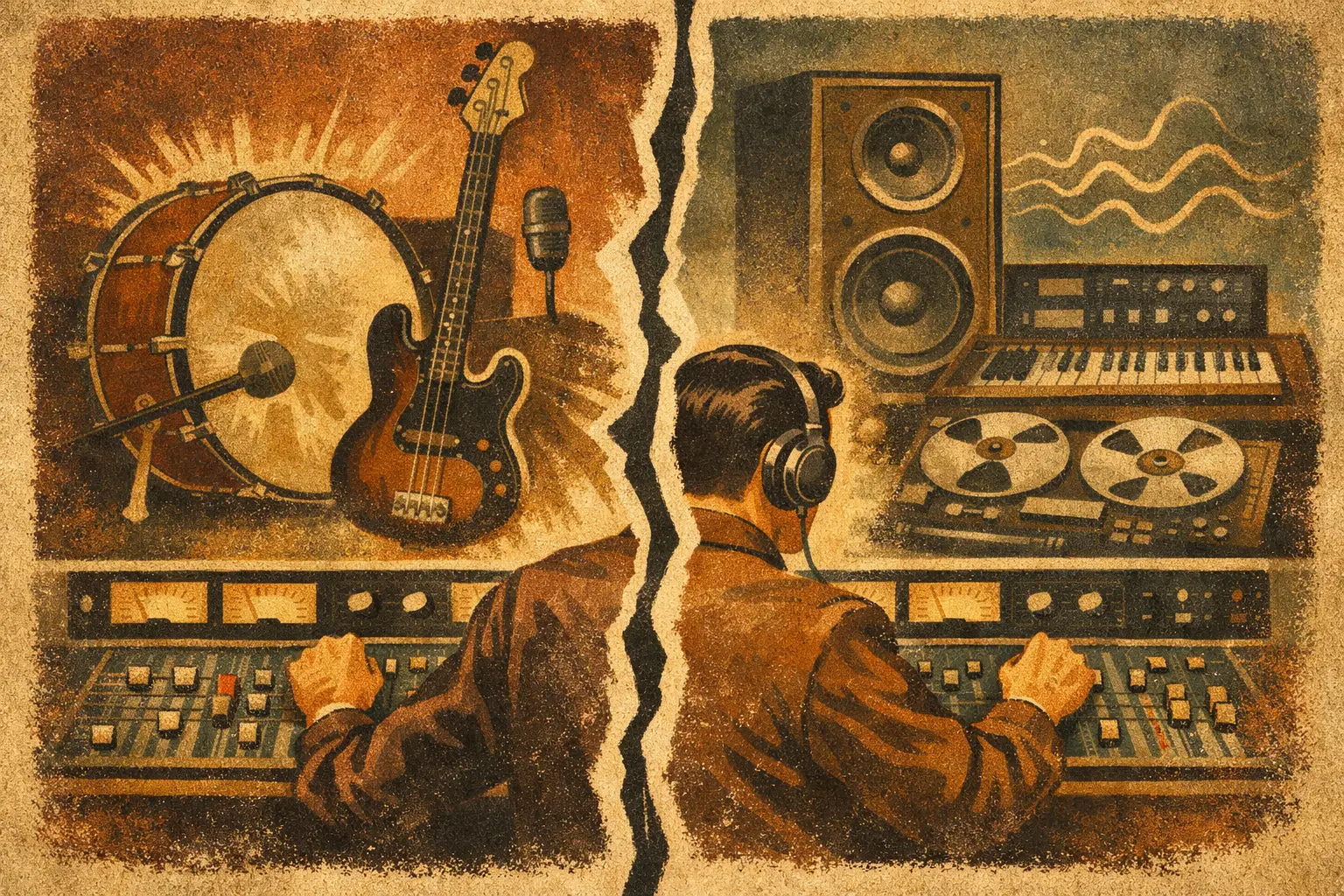
A kick and bass can both sound excellent in solo, then turn into a blurry, underpowered low end the moment they play together. That is the actual problem behind how to separate kick bass: not making either source smaller, but giving each one a clear job in the same limited frequency and time window.
The fix is rarely one dramatic EQ cut or a sidechain preset slapped on the bass. Separation comes from decisions that reinforce one another: choosing where each sound speaks, checking polarity and phase, managing sustain, creating narrow spectral pockets, and controlling the low end in mono. Do those in the right order and the mix gets louder, tighter, and easier to master without sacrificing weight.
Start by deciding who owns the lowest octave
Before reaching for a processor, identify the musical role of each sound. A 808-style bass may carry the sustained fundamental around 40 to 60 Hz, while the kick supplies its primary weight closer to 70 to 100 Hz and its attack above that. In another record, especially house or techno, the kick may own 45 to 65 Hz while the bass lives an octave higher.
There is no universal frequency chart that can make this decision for you. The key, kick tuning, bass patch, tempo, and arrangement all matter. What does not work is letting both sources demand maximum level at the same fundamental frequency for the entire track.
Listen to the kick and bass together in mono. If the low end seems to swell, disappear, or change character from note to note, you may have an ownership problem before you have an EQ problem. Choose a priority. The kick can be the short, physical impact; the bass can deliver length, pitch, and harmonic density. Or reverse that relationship deliberately. A clear hierarchy is more useful than trying to make both elements equally huge everywhere.
Fix timing and phase before EQ
A kick transient that lands exactly with a bass waveform peak can produce more level. It can also create a bulky hit that leaves no room for either sound to be heard. If their waveforms oppose each other at the fundamental, the result may be a weak low end even when meters say the tracks are loud.
Start with polarity. Flip the polarity on one channel and compare at matched gain. Keep the setting that produces the most stable low end in mono, not simply the biggest momentary peak. Then inspect timing. Moving a bass track by a few samples or milliseconds can substantially change how its first cycle interacts with the kick.
Be careful with this step. Aligning every waveform visually is not a mixing rule. A bass note has changing pitch, envelope, and harmonics, while a sampled kick has its own evolving frequency content. Use your ears across several notes and sections. If adjustment improves the verse but causes the chorus to lose punch, you may need a section-specific solution rather than one global delay value.
Create complementary EQ pockets, not broad scoops
Once the sources are timed sensibly, use EQ to make their roles obvious. First, identify the kick's weight frequency and the bass's strongest fundamental with a spectrum analyzer as a reference, then verify by listening. Broadly cutting 50 Hz from the bass because a tutorial said so is how a full arrangement becomes thin.
Instead, make small, purposeful moves. If the kick needs authority around 75 Hz, a modest dynamic dip in the bass around that range can open room only when it is needed. If the bass owns 50 Hz, a gentle reduction in the kick's low fundamental may let the bass stay solid while the kick gets its punch from 90 Hz and its beater definition higher up.
Dynamic EQ is often cleaner than static EQ because kick and bass collisions are not constant. A bass patch may only mask the kick on certain notes, or only when a dense chorus adds extra harmonics. Trigger a narrow to moderate bell on the bass from the kick, and reduce only a few dB when the kick arrives. The goal is a controlled pocket, not an audible hole punched into every bass note.
Also address the low-midrange. Mud commonly builds between roughly 150 and 300 Hz, where kick body, bass harmonics, guitars, synths, and vocals can stack up. If the low end has weight but lacks definition on smaller speakers, this area may be more responsible than the sub range. A small cut in the right source is usually better than boosting both channels until the master bus compresses around every downbeat.
Let harmonics carry the bass on smaller systems
Sub energy is felt more than heard on many playback systems. If a bass only works through 40 Hz, it may vanish on phones, laptops, and small Bluetooth speakers. Mild saturation or harmonic enhancement can create audible information around 100 to 300 Hz without asking the bass fundamental to become excessive.
This also helps kick-bass separation. When listeners can identify the bass by its harmonics, it does not need to compete as aggressively with the kick at the very bottom. Keep the processing level-matched while comparing. Saturation often sounds better simply because it is louder.
Use sidechain compression for shape, not for a pumping effect
Sidechain compression is useful because it handles the time dimension. EQ determines where the instruments fit; sidechain compression determines when they overlap. The bass ducks briefly as the kick hits, allowing the transient and first low-frequency cycle of the kick to register clearly.
Set the release according to the groove. At faster tempos, a release that is too long can make the bass feel late and cause the whole track to lose forward motion. At slower tempos, an extremely fast release can allow the bass back so abruptly that it masks the kick tail. Start by aiming for the bass to recover naturally before the next kick, then adjust by ear while the full rhythm section plays.
Do not assume more gain reduction means more separation. Two to four dB may be enough for a natural pop, rock, or hip-hop mix. Electronic styles may use deeper ducking as part of the production aesthetic, but that is a musical choice, not a corrective default. If you need 8 dB or more just to hear the kick, revisit arrangement, tuning, phase, and EQ.
A frequency-conscious approach is often better than full-band compression. Dynamic EQ or multiband ducking focused on the kick's fundamental range lets the upper bass harmonics continue, so the instrument retains note definition while its conflicting low-frequency energy steps aside.
Control sustain and arrangement density
Sometimes the bass is not masking the kick because it is too loud. It is masking the kick because it never stops. Long releases, overlapping MIDI notes, and sustained sub layers can fill every gap between drum hits. Tightening the bass envelope by a small amount may create more impact than another plugin ever will.
Inspect the arrangement too. A layered kick with a sub thump, acoustic body, and bright click may sound impressive alone but occupy three separate jobs. A bass made of sub, distorted mid layer, and wide stereo layer can do the same. Keep the layers that contribute something distinct, then remove or automate the rest. Separation is easier when each element is intentional.
For sections that need extra energy, automate the relationship rather than permanently overprocessing it. A sparse verse may tolerate more bass sustain. A dense chorus may need a slightly shorter bass release, deeper kick-triggered dynamic EQ, or a modest level change. This is where stem-level workflows are more useful than a stereo-file fix: the conflict can be addressed in the source relationship instead of compressed into a finished two-track.
Keep the foundation mono and check at real levels
Low frequencies are difficult to localize, and wide sub content can create unstable playback when a mix is summed to mono. Fold the lowest bass information to mono, commonly somewhere below 100 to 120 Hz depending on the material. The exact crossover is not sacred. A bass with meaningful stereo texture at 140 Hz may need a lower fold point; a synthetic sub with no useful width can be mono much higher.
Then check the mix in mono, quietly and at a reasonable monitoring level. At low volume, the kick should still announce the rhythm and the bass should still imply pitch and movement. At louder levels, neither should cause the limiter to collapse around every kick hit.
If you are using automated stem processing, do not treat its kick-bass decision as a hidden verdict. StemMaster can identify the roles, apply spectral unmasking and stem-aware dynamics, then show what changed through visible faders and plain-English Engine Notes. A/B the result at matched loudness, inspect the low-end moves, and override them if the track's creative intent calls for a different balance. Automation should make the first pass faster, not make the final decision for you.
The best kick-bass relationship is not the one with the most processing. It is the one where the groove stays obvious, the sub stays stable, and both instruments still feel like themselves when the rest of the record arrives.