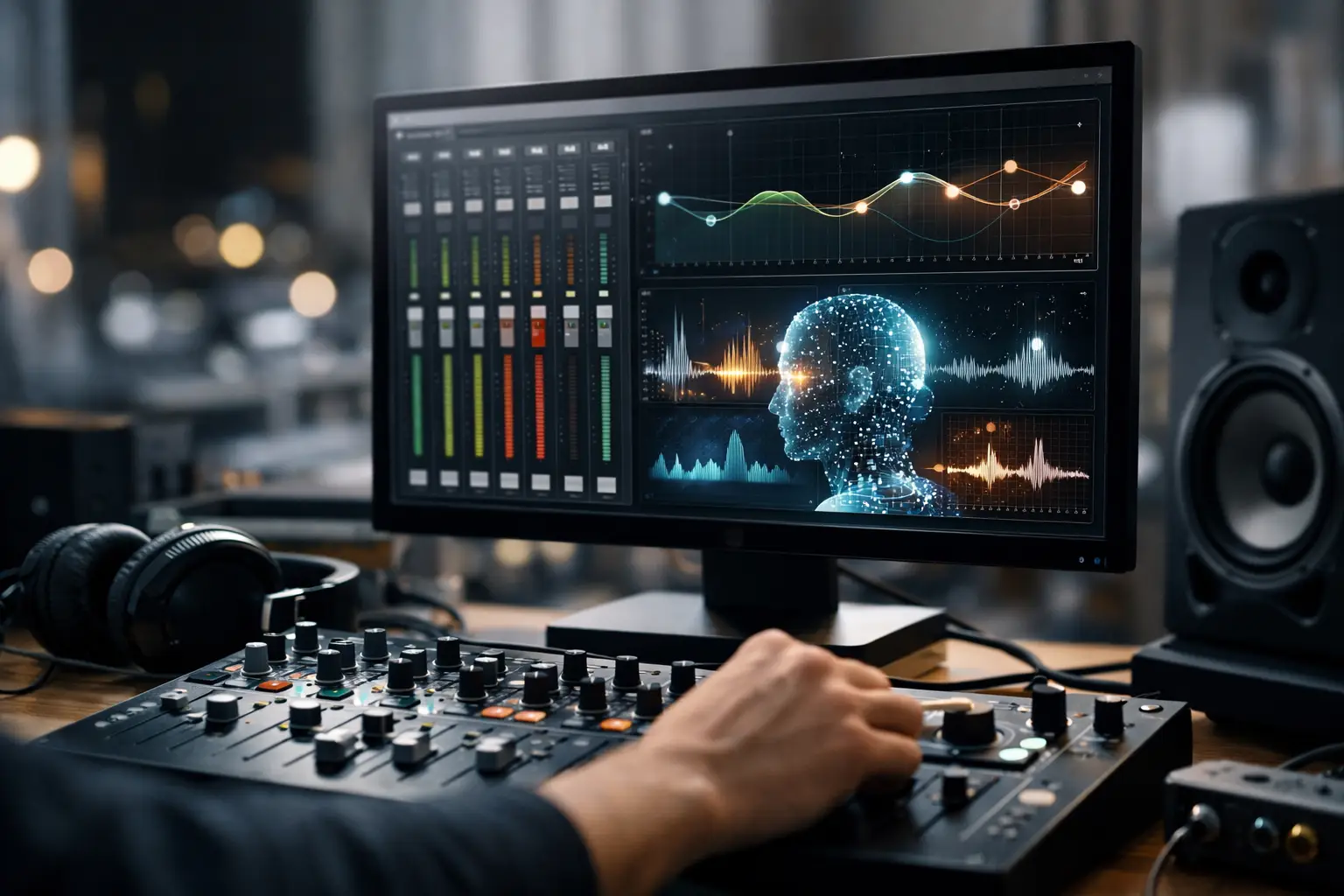
A vocal can be technically audible and still feel buried. A kick can hit hard on its own, then disappear when the bass enters. Those are not preset problems. They are relationship problems, and explainable ai mixing software should show you how it addressed them instead of handing you a louder file and expecting gratitude.
For producers working from four to forty exported stems, the appeal of automation is obvious. You want a finished record without spending an evening drawing vocal rides, hunting low-mid buildup, checking mono compatibility, and chasing a final limiter. The catch is control. If software cannot tell you what it changed, when it changed it, or let you revise the result, it is not acting like an assistant engineer. It is acting like a black box.
What Explainable AI Mixing Software Actually Means
Explainability is not a decorative panel full of vague confidence scores. In a mixing context, it means the software exposes the engineering decisions that affect the record: gain staging, role detection, equalization, compression, stereo management, automation, and final loudness handling.
A useful system can identify that one stem functions as a lead vocal, another as a kick, another as bass, and others as supporting instruments or effects. That classification matters because the right treatment depends on musical role. A lead vocal may need section-specific level automation and spectral unmasking against guitars or synths. Bass may need low-frequency control and a mono-bass fold below 120 Hz. Drums may need transient-aware compression rather than the same broad processing applied to every file.
The explanation must connect a technical action to an audible reason. “Reduced competing energy around the vocal presence range during the chorus” is useful. “AI enhancement applied” is not. The first statement gives you something to hear, challenge, and adjust. The second asks you to trust a process you cannot inspect.
Visibility changes the workflow
When faders visibly move, automation stops being magic. You can see that the lead vocal rises into a dense chorus, settles back after the hook, or receives a small lift at the end of a line. You can decide whether that move supports the performance or overstates it.
The same applies to corrective EQ. If the system identifies spectral masking between bass and kick, you should be able to inspect the decision and hear the before-and-after at matched loudness. A half-dB improvement in separation may be the right call. A more aggressive cut may clean the meter while removing the weight that made the beat work. Explainability keeps that judgment with the producer.
Why Stem-Level Decisions Matter More Than Stereo Guesswork
Stereo-file mastering services work from a finished two-track. They can shape tonal balance, dynamics, width, and loudness, but they cannot turn down a harsh hi-hat without also affecting the vocal and synth information sharing that frequency range. They cannot ride the hook vocal independently. They cannot create space between a kick and bass that have already been printed together.
Stem-level processing has more context. With separate tracks, an automated engineer can make targeted decisions: reduce a masking instrument only when the vocal is active, control a bass resonance without thinning the full mix, or contain wide effects while protecting the center image. It can also respond to arrangement changes. A sparse verse and a crowded final chorus rarely need identical treatment.
That does not mean every stem should be heavily processed. Good automation knows when to leave a track largely alone. A well-recorded acoustic guitar may only need level placement. A drum bus that already has the intended color may need gentle headroom management rather than another compressor imprint. The objective is not to make every channel look busy. It is to make the record translate.
The Evidence You Should Expect From the Software
A credible explainable AI mixing software workflow gives you evidence in forms you can use while listening. Readable Engine Notes are one part of that evidence. They should describe the action in plain English and identify the musical reason: vocal lift in a chorus, low-mid cleanup on competing accompaniment, controlled sibilance, or peak containment ahead of mastering.
Visual feedback is another part. Watching channel faders, processing states, and section-based automation makes the mix legible. If a vocal ride is too assertive, you know where to intervene. If a background texture gets attenuated only when it conflicts with the lead, you can assess whether that trade-off preserves the intended atmosphere.
Matched-loudness A/B is equally necessary. Louder almost always sounds more exciting for the first few seconds. Comparing the processed master against the original within a tenth of a dB removes that easy illusion. Now you can hear whether the vocal is clearer, whether the low end is more stable, and whether the mix has gained impact or merely gained level.
Finally, every important decision needs an override path. Automation should save time, not confiscate authorship. If you want more vocal intimacy, less stereo control on a pad, or a different balance between kick and bass, you should be able to revise an individual stem after the system has done its first pass.
A Practical Way to Judge the Result
Start with your exported stems at sensible levels. Do not normalize every file to the ceiling or print a brickwall-limited mix bus into every group. Leave room for the system to assess balance and dynamics. WAV is the cleanest handoff when available, though FLAC and MP3 support can be useful for works in progress.
After processing, listen in three passes. First, listen for the song. Does the hook arrive with the intended emotion? Is the vocal relationship believable? Second, listen for conflicts: kick versus bass, vocal versus lead instruments, cymbals versus vocal consonants, and excessive width that vanishes in mono. Third, inspect the decisions that caused the changes.
Do not assume the most active-looking mix is the best one. If an automated system has made many fader moves, ask whether the arrangement truly demanded them. If it has used little processing, ask whether it missed a problem or correctly respected a strong starting mix. Context decides the answer.
Master-stage processing deserves the same scrutiny. A 4x oversampled true-peak limiter can help prevent intersample peaks and deliver competitive level, but louder is not automatically better. A dense electronic track may tolerate more limiting than an acoustic performance that depends on transient contrast. A transparent system should let you hear that trade-off rather than bury it behind a genre label.
Local Processing Is Part of the Trust Model
Audio files are often unreleased work. Sessions may contain client vocals, label-bound material, or simply ideas a producer does not want copied to a remote server. Uploading stems to an online processor creates another dependency: account access, connection speed, server availability, changing terms, and an unknown retention policy.
Local desktop processing removes that chain. The work stays on your Windows machine, and the system remains available without treating an internet connection as permission to use the tool you bought. No cloud service wearing one as a costume, no mandatory account, and no telemetry required to finish a record.
That model also supports repeatability. You can process a revision, compare it to the previous pass, make a stem-level adjustment, and export again without rebuilding an upload queue. For a producer balancing multiple client deadlines, that is not a minor convenience. It is a workflow advantage.
StemMaster approaches this directly: it analyzes multitrack stems locally, displays its processing rationale in readable Engine Notes, and lets you inspect the mix before committing to export. The point is not to replace your taste. It is to handle the repetitive engineering work quickly enough that your taste gets more of the session.
The Standard Is Not “AI,” It Is Accountability
An automated mix can be impressive on a first listen and still fail the real test. Can you identify why the vocal is clearer? Can you hear whether the bass treatment improved translation? Can you pull back a decision that changed the character of the production? Can you compare the result without being fooled by a louder output?
Those questions separate an engineering tool from an opaque result generator. The best automated pass is not the one that makes the most dramatic changes. It is the one that gives you a stronger record, a clear rationale, and enough control to make the final call yourself.