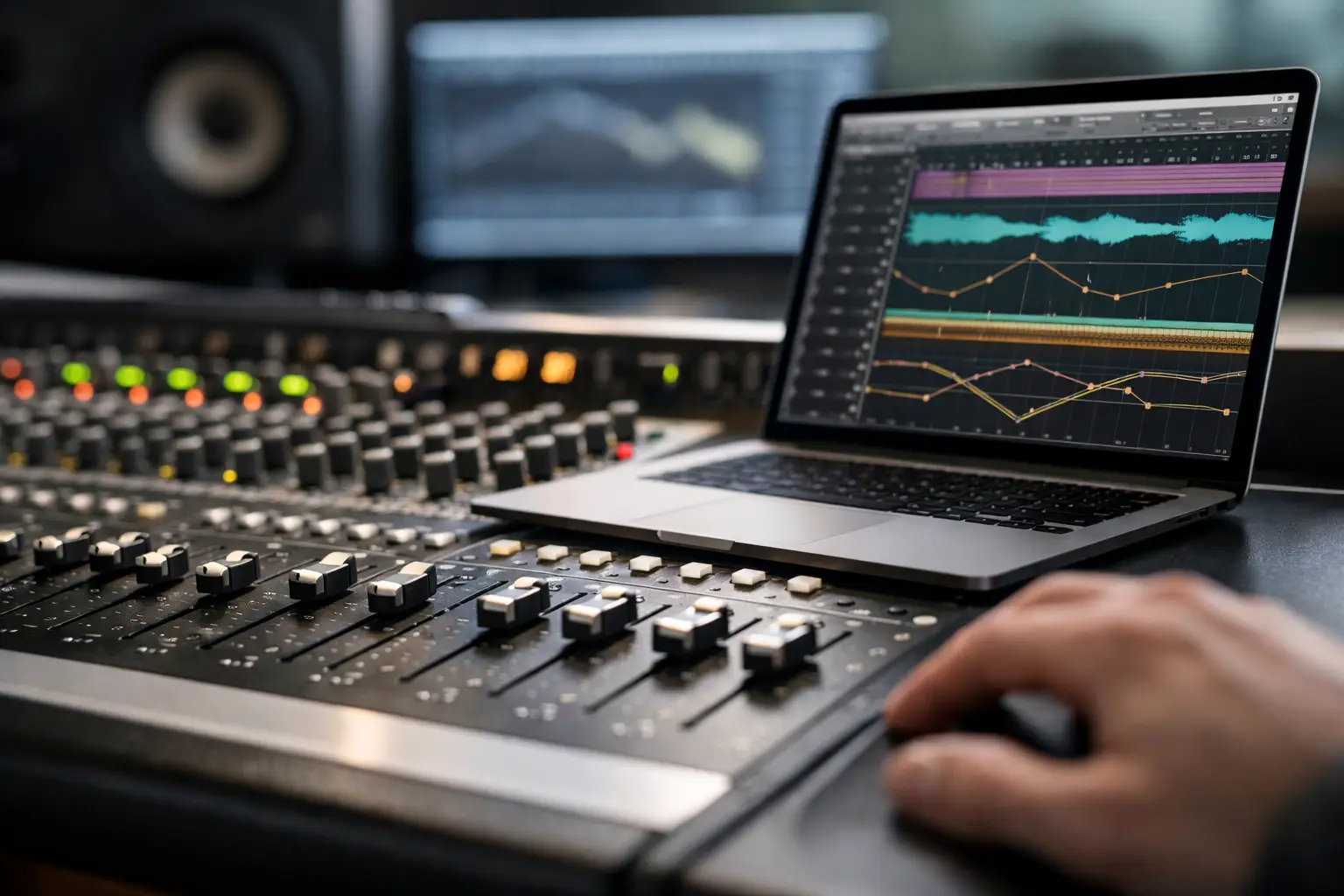
A vocal that disappears in the pre-chorus is not a mastering problem. A kick and bass fighting for the same low-end space is not fixed by turning up a limiter. Those are mix decisions, and automatic mix automation is only useful when it can make those decisions at the stem level, show its work, and leave you with the final say.
That distinction matters because plenty of tools promise an instant finished track. Most hear a stereo file, apply a generalized loudness curve, and return something brighter, louder, and harder to evaluate. That may be acceptable for a rough reference. It is not the same as analyzing individual drums, bass, vocals, music, effects, and instrument stems, then treating the conflicts between them with purpose.
What Automatic Mix Automation Should Actually Automate
A real stem-aware system starts before processing. It needs to identify likely musical roles, inspect level relationships, detect spectral collisions, and understand how energy changes from section to section. A lead vocal may need more presence and a small level lift when the arrangement becomes dense. A bass may need controlled dynamics and a mono fold below 120 Hz. Wide pads may need restraint when they crowd a vocal or weaken translation in mono.
None of those moves should be treated as permanent creative law. They are engineering responses to measurable conditions. The point of automation is to handle repetitive judgment calls quickly, not to erase the producer's aesthetic.
This is where a stem workflow earns its place. With separate files, the system can apply vocal rides without raising the snare, clean low-mid buildup from a music bus without thinning the vocal, and manage kick-bass interaction without flattening the entire record. A stereo-file service cannot reliably separate those jobs after the mix has been printed.
The best automatic mix automation also changes by section. A verse with sparse instrumentation can support a more intimate vocal balance than a packed chorus. An outro may benefit from a wider texture or a controlled level taper. Static settings can make a song technically clean while still feeling lifeless. Automation exists because songs move.
The Difference Between Fast and Opaque
Speed is valuable. Blind speed is not.
When an AI mix tool gives you a result with no visible fader movement, no explanation, and no matched-level comparison, you are being asked to trust an outcome you cannot properly inspect. Louder almost always sounds more impressive in a quick comparison, even when it has less punch, less depth, or more distortion. That is why loudness-matched A/B comparison is not a decorative feature. It is the minimum standard for honest evaluation.
Transparent automation should let you see the level changes it makes. It should explain, in plain English, why it applied spectral unmasking, dynamic EQ, compression, width control, or gain automation. It should let you override a decision after processing rather than forcing you to rebuild the session from scratch.
That does not mean every creator needs to audit every parameter. Sometimes you need a finished reference before a client call. Sometimes you have 24 stems from a beat session and want a clean starting point in minutes. The value of readable decisions is that control is available when the record needs it. You can accept the work, refine it, or reject one move without abandoning the entire result.
A Practical Stem-Level Workflow
The workflow should be short enough to use on real sessions, not just demos. Start with organized stem exports: WAV is preferred when available, but FLAC and MP3 can be practical depending on the source. Export tracks so they share the same start point, even if some stems are silent at the beginning. Avoid printing a limiter across every individual stem unless that limiting is part of the sound you intend to keep.
Next, give the automation room to assess the arrangement. Four stems can be enough for useful results - for example, drums, bass, music, and vocals. Forty stems can support more precise decisions, particularly when a session includes layered vocals, percussion, synth groups, guitars, effects, and alternate low-end elements. More separation provides more opportunities for targeted control, but it also makes clean exports more important.
After analysis and processing, listen in a deliberate order. First, compare the processed master against the original at matched loudness. Listen for vocal intelligibility, kick definition, bass consistency, transient impact, stereo stability, and whether the chorus still opens up. Then inspect individual stem changes. If the vocal ride feels too assertive, reduce it. If the low end was tightened more than the genre calls for, restore some weight. Automated engineering should shorten the path to judgment, not replace judgment.
StemMaster is built around that approach: local stem analysis, visible fader behavior, readable Engine Notes, post-process overrides, and export without sending a song to a cloud queue. That is a different proposition from online mastering dressed up as mix automation.
Where the Engineering Happens
Good automation is not one processor with an AI label. It is a coordinated chain that responds to the material.
Balance and Vocal Rides
Level is still the highest-impact mix control. A system can make careful gain decisions across stems, then apply section-aware automation where the arrangement changes the perceived balance. Vocal rides are especially useful because a vocal can be technically audible while still losing authority on certain words, notes, or phrases.
The trade-off is obvious: over-automation can make a vocal feel pinned in place and remove natural performance dynamics. The correct result is not maximum consistency. It is intelligibility and emotional continuity without hearing the hand of the process.
Spectral Unmasking and Dynamic Control
Spectral masking occurs when important elements occupy competing frequency ranges at the same time. A vocal and bright guitar may collide in the presence range. A bass and kick may compete for low-frequency authority. Stem-aware spectral unmasking can make measured, dynamic space when a conflict occurs instead of permanently scooping the entire source.
This is preferable to broad, static EQ in many cases, but not all. If a synth is fundamentally too harsh or a vocal recording has a persistent boxy resonance, a stable EQ correction may be the cleaner answer. Automation should respond to changing conflicts. It should not manufacture movement simply because movement sounds advanced.
Stereo Field and Low-End Translation
Width is another area where automatic processing needs restraint. Pads, background vocals, and effects can often carry width without harming the center image. Lead vocal, kick, bass, and snare usually need more stable center placement. Folding bass content below 120 Hz toward mono can improve playback reliability on clubs, cars, phones, and consumer speakers, especially when the source contains phase-heavy low end.
But genre and source matter. A deliberately wide electronic bass texture may be part of the record's identity. The purpose is not to enforce a rulebook. It is to flag and control the part of the spectrum most likely to lose impact outside your studio.
Final Loudness Without Flattening the Mix
The final master still needs controlled loudness and true-peak protection. A 4× oversampled true-peak limiter can catch intersample peaks that a basic sample-peak meter may miss. Used correctly, it raises competitive level while keeping transient damage and audible distortion in check.
Used aggressively, it can turn a detailed stem mix into a small, fatiguing wall. There is no universal LUFS target that makes every release correct. A dense rap record, an aggressive EDM track, an acoustic song, and a dynamic indie production may require different compromises. The right question is whether the master keeps its impact when level-matched to the original, not whether it wins a number contest.
Why Local Processing Is Part of the Workflow
Audio files are not just data. Unreleased vocals, client sessions, label work, and works in progress deserve a workflow that does not require upload, an account, or a subscription timer to function. Local processing also removes the uncertainty of file queues, browser failures, changing server behavior, and an internet connection becoming part of your studio chain.
For Windows-based producers and small studios, standalone software has another advantage: ownership is clear. You install it, process your work, and keep working. No cloud service wearing one as a costume, no mandatory telemetry, and no need to hand over a session simply to hear what an algorithm does to it.
Automatic mix automation is at its best when it gives you back the hours spent chasing routine balance and cleanup, then leaves your ears in charge. Export clean stems, test the result at matched loudness, and keep the decisions that make the song feel more like itself.