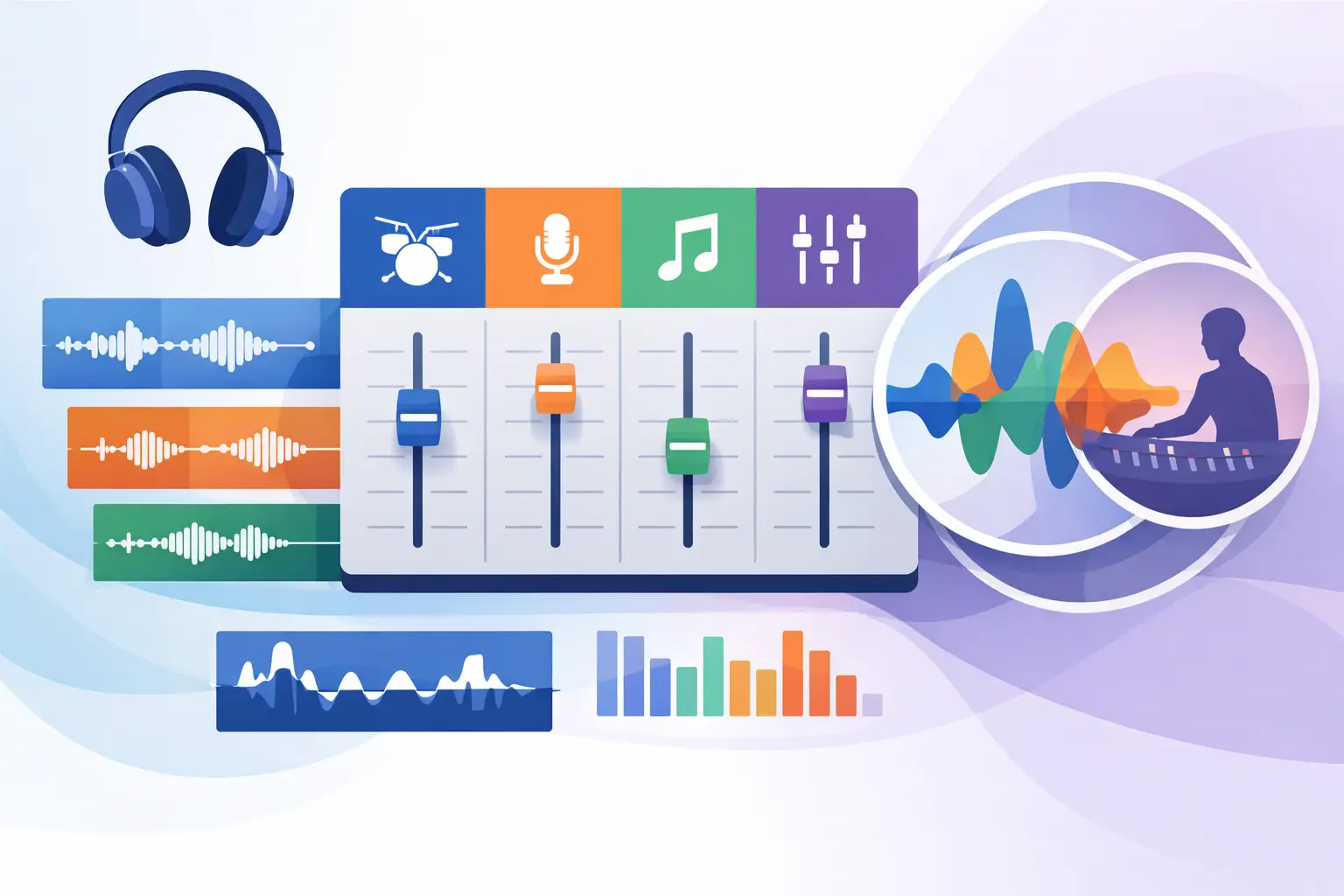
A stem aware equalizer does not treat your mix like one finished stereo file with a problem somewhere inside it. It can examine the vocal, kick, bass, guitars, synths, and percussion as separate sources, find where they compete, and make a smaller move on the stem that is actually causing the collision. That distinction is the difference between clearing a vocal and hollowing out an entire master.
For producers working from four to forty exported stems, EQ is rarely just about making one track sound brighter or warmer in solo. The real work is deciding which part gets priority at a specific frequency, at a specific moment, without flattening the arrangement that made the record interesting in the first place.
What a Stem Aware Equalizer Actually Does
A traditional stereo equalizer only sees the summed result. If a lead vocal feels buried around 2.5 kHz, stereo EQ can add presence to the whole song or cut that range from the whole song. Either choice affects cymbals, guitars, synth attacks, snare crack, and whatever else lives there. It may improve one symptom while creating three new ones.
A stem-aware equalizer starts with context. It identifies likely musical roles, measures overlapping energy between stems, and asks a more useful question: which source is masking which source, and does the conflict remain constant through the song?
Consider a dense chorus where distorted guitars cover the lead vocal's intelligibility band. A sensible move may be a narrow, dynamic reduction on the guitar bus only when the vocal is active. In the verse, where the guitar arrangement opens up, that reduction may disappear. The vocal becomes easier to understand, but the guitars do not lose their edge for the entire track.
That is spectral unmasking in practical terms. It is not a magic “clarity” button. It is controlled prioritization between sources that are fighting for the same perceptual space.
Why Static EQ Often Misses the Real Problem
Static EQ is still useful. A bass with excess mud at 250 Hz may need a consistent cut. A harsh hi-hat may need a stable high-frequency shelf adjustment. But many mix conflicts are conditional. They appear when a singer pushes into a chorus, when an 808 hits under a kick, or when a bright synth layer enters for eight bars.
Applying a permanent cut because of a temporary collision is overcorrection. You can end up with thin guitars, a weak bass, or a vocal that sounds unnaturally detached once the arrangement gets sparse.
A well-designed stem-aware process can use dynamic EQ, level-aware behavior, and section-specific automation instead. It can make room only when room is needed. The trade-off is that dynamic processing must be conservative and observable. If it reacts too aggressively, the mix starts to breathe or shift tonally in a way the listener can feel, even if they cannot name it.
That is why “AI EQ” is not enough as a description. The important questions are what moved, when it moved, how much it moved, and whether you can disagree with it.
Vocal intelligibility is not just a high-mid boost
The fastest bad fix for an unclear vocal is often boosting its top end. Sometimes that works. Often it brings up sibilance, headphone harshness, and room noise while the actual masking remains untouched.
A vocal can be masked by low-mid buildup from guitars and keys, by snare and synth energy in the presence range, or by a bass-heavy arrangement that makes the entire mix feel congested. The right response depends on the stems. It may be a subtle vocal lift, a dynamic dip on a competing instrument, light de-essing, or a combination of all three.
A stem-aware equalizer can make those choices with less collateral damage because it has access to the competing sources. The final stereo bus does not need to carry the burden of solving every internal balance problem.
Low end needs priority, not more low end
Kick and bass conflicts are another common example. A stereo EQ can reshape the combined low end, but it cannot decide whether the kick transient or the bass fundamental should lead on each hit. With stems, processing can preserve the kick's punch while controlling the bass energy around the overlap, or stabilize the bass while allowing the kick to cut through.
This is also where mono-bass fold below 120 Hz can be useful. It keeps the lowest energy centered for more reliable translation on club systems, phones, and mono playback. It is not a rule that every record needs to obey at the same frequency. A wide electronic sub effect may be intentional. A good system should make the move visible and leave the artistic call with you.
The Difference Between Automation and a Black Box
Automation earns trust when you can inspect it. If a system says it improved your mix but gives you no fader movement, no processing notes, no gain-reduction context, and no matched comparison, you are being asked to accept a result on faith.
That is a poor fit for producers who already know their sessions. You may want speed, but you do not need to surrender judgment.
The useful workflow is simple: import cleanly labeled stems, allow the system to analyze roles and relationships, then review the resulting balance and notes. If the vocal was raised 1.2 dB in the final chorus, you should be able to see that. If a pad received dynamic attenuation to make space for the vocal, the reason should be stated in plain English. If the kick and bass were separated through targeted EQ, you should be able to audition the change at matched loudness.
Matched loudness matters because louder almost always sounds more impressive in a quick comparison. An A/B test within a tenth of a dB gives you a fairer answer: did the mix actually become clearer, punchier, wider, or more controlled, or did it simply get louder?
StemMaster takes this approach by showing its fader moves, documenting its decisions in readable Engine Notes, and allowing individual adjustments after processing. That turns automation into a starting point you can verify, not a verdict you have to live with.
Where Stem-Aware EQ Helps Most
This approach is especially useful when the production is crowded but the individual sounds are already close. You may have a good vocal recording, a good beat, and strong sound selection, yet the exported mix lacks separation. The problem is often interaction rather than source quality.
It also helps when a song changes density from section to section. A chorus may need vocal priority over stacked guitars and synths, while a stripped verse needs the same vocal processing to relax. Section-specific decisions avoid a one-size-fits-all curve that favors only the loudest part of the arrangement.
There are limits. Stem-aware EQ cannot repair a vocal recorded with severe clipping, invent detail missing from a muddy sample, or make an arrangement with six lead instruments feel naturally spacious without creative choices. It can identify conflicts and apply disciplined correction, but it cannot decide which hook matters most if the production itself has not made that decision.
It also depends on stem quality. Export stems from the same session start point, avoid master-bus limiting or clipping baked into individual tracks unless it is intentional, and label files clearly. A clean export gives analysis a reliable picture of the record. Randomly named files and heavily printed bus processing make any automated decision less certain.
Use the Result as a Mix Decision, Not a Finish Line
The strongest use of a stem-aware equalizer is not “press a button and never listen again.” It is shortening the tedious diagnostic phase so you can spend your attention on creative calls.
After processing, listen to the chorus, the busiest transition, and the quietest section. Check whether the vocal remains present without sounding pushed forward. Check whether the kick and bass feel defined rather than carved apart. Collapse to mono and make sure the low end still holds together. Then compare against your original at matched loudness.
If a move improves separation but removes character, pull it back. If the automation finds a conflict you had been chasing for an hour, keep it and move on. The point is not to let software have the last word. The point is to make the next word yours, with better information and a mix that is already closer to release-ready.